
Glass, then light
The telecoms bust in the early 2000s is usually remembered as a demand story. While internet traffic doubled every year from 1997 onwards the industry was built out for a different growth rate of doubling every three to four months. Why did that happen? It started in UUNET marketing, made it into policy consensus in the Commerce Department’s 1998 Emerging Digital Economy report and from there into everyone’s business plans. Narratives can and often do shape reality. Andrew Odlyzko at AT&T Labs spent 1998 to 2002 pointing out that the measured figure was 100% a year, not 1,000%. Nobody wanted to hear it because there are fees in capital booms and bears can “have fun staying poor”.
Getting demand growth wrong by that margin is bad enough but what was happening on the supply side made it worse - far worse. Wavelength division multiplexing sends many colors of light down one strand instead of one. Ciena’s first commercial system in 1996 put 16 channels of 2.5 Gb/s on a fiber. By 2001 deployed systems carried 80 to 160 channels at 10 Gb/s each. Call it 300 to 600 times the per-strand capacity in six years, almost all of it arriving at the end. Productivity shocks in technology are like nothing else: there is no equivalent speed of improvement for pouring concrete and even solar cost declines pale in comparison here. Demand doubled annually. Per-strand capacity was doubling every nine months, and that is before you count the strands themselves, which went up by an order of magnitude as every new entrant dug its own trench and reasoned “well, that’s a big whole might as well put some more fiber in since it isn’t much work to do so”. Multiply those together and the supply exponent is several times the demand exponent. No amount of real demand growth saves you from that. As a corporate you have missed the landing zone and whether you can walk back depends on how you are funded.
The result was the dark fiber glut, something like $100 billion of long-haul fiber that was never lit, a collapse in bandwidth prices, and WorldCom, Global Crossing and a good part of Lucent and Nortel. The customer won completely. Everything we now call the cloud was built on glut-priced glass. The capital that paid for it did not come back.
The trench is the problem
The mechanism is laid out properly in a paper I keep coming back to, Kurebayashi, Osgood and Gillett’s system-dynamics model of the long-haul bubble. Three things in it matter.
First, construction dominates cost. The trench and the rights of way are the expense; the glass is cheap. So every operator lays far more strands than its forecast implies, because the marginal strand is nearly free and nobody wants to dig twice. Second, the build takes years. Level 3 needed roughly 1997 to 2001 for its US network, and a four-year build forces a four-year forecast in an industry with three years of reliable data. Third, the multiplexer keeps improving while you dig. Capacity per strand went up about two and a half times a year through the bubble, so the capacity that showed up at commissioning was an order of magnitude more than the capacity that was planned, on a strand count already padded for construction economics.
Their counterfactual runs are telling. If you slow WDM down in the model the carriers still overbuild due to long term capital decisions vulnerable to shorter term demand dynamics. This is classic beer distribution game stuff without the productivity shock. What changes is who gets hurt. Fast WDM meant fewer strands were ordered than a slow-technology world would have needed, so the cable makers were cushioned relative to the alternative. Corning still lost about 99% of its value, mind, but it would have fallen from higher.
Accurate demand data would have made the bubble smaller, not absent. The incumbents had the data and sat on it. The new entrants planned off the press releases but did not dig into proceedings at IEEE or technical conferences that disclosed rapid progress that might completely change the path of supply. There was across the board a notable lack of system level thinking noted in Dietrich Dorner’s “The Logic of Failure: Recognizing And Avoiding Error in Complex Situations”. Some parallels exist here in that those who had the R&D and technical talent to see what was coming were in the business of selling the product and did not care much for the wisdom of their customers though they probably should have as they leaned deeper into vendor financing.
Power is the trench, photonic compute is the multiplexer
Now swap the nouns. The expensive, slow, irreversible thing in the AI buildout is not the chips but the physical overhead to power them. Grid interconnection, transformers, gas turbines, substations and the permitting around them carry the same three-to-five-year lead times that trenching and rights of way did. The big four hyperscalers have guided to around $700 billion of capex for 2026, there are more than 20 GW of datacenter capacity under construction globally, and campuses are being sized at a gigawatt and up against demand forecasts for 2028 to 2030.
In my last piece on this I wrote the cost of a token as the cost of energy, times how well power becomes floating-point operations, times how well software turns those into tokens. The middle term is the multiplexer. Photonic compute does the matrix multiplication that is most of an LLM in light rather than in switching transistors, and the claimed gains are of the same order as WDM’s were.
Lumai, out of Oxford, does the multiply in free space, in three dimensions, and in April shipped an inference server running Llama 70B on a hybrid digital-optical processor, claiming up to 90% lower energy than a GPU system. Opticore, out of MIT, USC and Berkeley, keeps the light in waveguides on a chip, time-multiplexes to encode a trillion parameters on one die, and claims 100x the energy efficiency and 25x the density of a leading GPU, fabbed on lagging nodes. Disclosure: I was Opticore’s first investor through Sagax, so weight accordingly.
These are claims from early-stage companies and I would not bet the farm on any particular multiple. I would bet on the sign. Even a 10x on the tensor share of rack power, which is most of it, is a WDM-class shock. And it arrives on the same schedule as the last one: after the trench is dug and before the demand it was dug for.
Where the deflation lands
Distance from the token buyer is the exposure, the same way distance from the end user was in 2001.
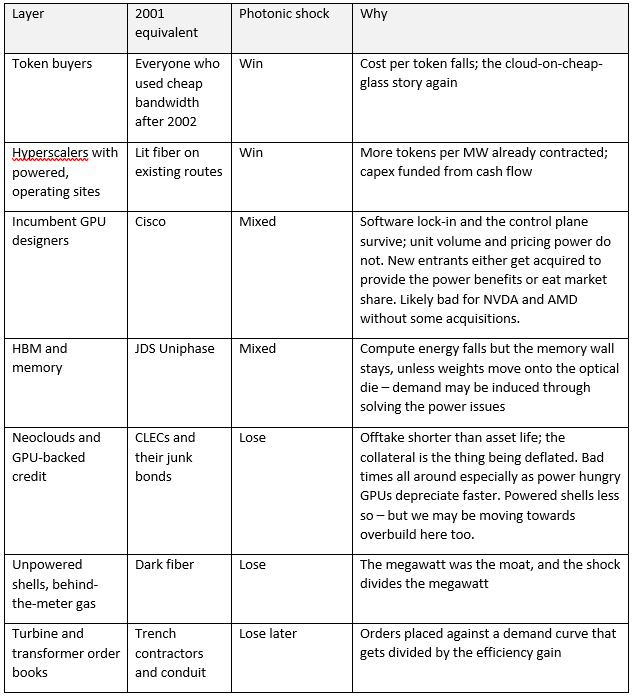
Two subtleties here are important. The glut did not hurt everyone who owned fiber equally; it hurt everyone whose fiber was unlit and whose debt was due and those who had funding and no debt still had to take severe price deflation on the chin. An operating datacenter with a signed power contract and tenants is lit fiber: a 10x efficiency gain means ten times the tokens out of the same substation, which is the best news those owners could get. The datacenter that exists as a land option, an interconnection queue position and a term sheet with a turbine supplier is dark fiber. They are - and this is non-technical language - cooked.
The second is vendor financing. Lucent and Nortel did not die because routers got cheap. They died because they had lent the money to the CLECs who bought them and could not repay. There are obvious parallels to NVIDIA’s vendor financing of neoclouds here. If the leases are shorter than the life of the collateral there is massive residual risk - like the value of a car at the end of an auto lease. If the collateral is the thing being made obsolete, that is where the loss concentrates, and whichever chip vendor is carrying the paper is Lucent.
What is different, and what to watch
Three things are different and only one of them is comforting. The hyperscalers fund this out of operating cash flow mostly - or at least did until recently - where Global Crossing funded it out of junk bonds, so the core of the system has a cushion the 2001 core did not. Less comforting: the demand exponent may well be real this time, token growth is fast, but the fiber lesson was that a real demand exponent does not protect you from a faster supply exponent. Compute platform lockin looks less sticky than it once was with AI programmed kernels from the like of Openai’s Jalapeno chip. Speed of descent is going to be driven by how good AI is getting at writing to bare metal – and it is already very good.
The things I would watch:
1. A photonic system running a frontier-sized model with tokens per joule published by someone other than the vendor.
2. A hyperscaler evaluation turning into an offtake agreement.
3. Guidance language shifting from gigawatts to tokens per megawatt or any signal that iron laws built around FLOPS/W start to bend.
4. Transformer and turbine order cancellations, then neocloud credit spreads.
5. Notable pushback from shareholders on capital spending - visible today in the failed Firmus listing, Coreweave’s stock and the market response to Meta fundraising.
The 2001 bust was not a failure of the internet as paradigm for communication and AI will not become useless all of a sudden. In the end, it was assets not generating the income they were expected to and capital being depreciated faster than had been modelled. Every long-dated power commitment signed this year is a bet that the photonic compute is late.
Addendum
Now for a little game theory. You are a large public company that is now in the borrowing to invest business for AI. If you saw this shock coming what would you do? Cut capex? Slow development? Probably. But how do you communicate this to shareholders and stakeholders and then not have a number of your suppliers experience a sudden stop in funding and collapse in the interim? Much of the C suite at hyperscalers has embraced the spirit of Julius Evola and is “riding the tiger” of this boom. The question is how will they get off and as they borrow like their neoclouds did previously, how do they dismount?
Perhaps this is collective action problem, and all must ride the tiger until it collapses under the weight of its funding requirements. The notable exception here is Apple who may be the shrewdest of all in having not played the game at enormous cost with no meaningful first mover advantage to then be able to sweep up the remains at the end of the day.
Maybe I’m missing something but the counter argument you’re likely to hear is that even if this happens customers will just use 100x the tokens.
I personally don’t think the demand for tokens is effectively infinite but some people seem to.
It's interesting to see so many words spent on a technology that revolves around IP theft